Saturday, 29 October 2011

Gallery commissions - and pricing your Artwork

The other day I ran into an interesting piece by Barbara Joy Smit, Art Agent. Although her article is written from the 'gallery side', I could relate to it and wanted to share it with you (although it is not specifically about aquarelle) because I think it's always good to be reminded that even artists should sometimes think businesslike!
But - the article is in Dutch. Barbara gave me permission to use it anyway - so here's the gist.
And click here for the original article.
  
As you probably know, galleries usually*) ask a commission for every artwork they sell. And often, artists add the amount of the commission to 'their' price.
But maybe that is not such a good idea after all:
A client, who has seen your work in a show, contacts you because he is interested to buy - and likes to know your price, or if you are interested to give a discount. The client comes to you, it is his initiative, so you don't have an obligation towards the gallery... or do you? Or - the client buys a piece in a gallery and later visits your atelier and sees similar work for much lower prices. Or talks to a direct client of you who paid much less... Painful! Won't make anybody feel good.


Now a gallery is a commercial company and they want to make a profit, so they ask a commission. Your own price is probably roughly based on materials and hours, but you haven't included commission because up to now you have sold directly to your clients. If the gallery's percentage is deducted from your price there's not enough left!
Likely your message to the gallery will be: the commission is going to be added.


OK - ask yourself: how much have you invested in marketing to sell your work? What does your work space cost, do you have a website, do you participate in tradeshows, do you have a portfolio, flyers, business cards? These are costs that you have probably paid out of your 'hours'. You have paid for them yourself but it actually makes more (business) sense to make these costs part of the sales price.

As a professional artist you are also an entrepreneur. Look at a loaf of bread you buy, you don't just pay for the ingredients and the baker's salary, there's also a calculation of the bakery's rent, the delivery car, the write-offs of the ovens, the insurance, the accountant etc etc... everything is included in the price of your bread. If a baker does it, why shouldn't you?
You should incorporate your business cost, the money you pay in order to create and sell your work, in your price - and when you outsource the marketing and sales of your work to a gallery, they make these costs. So it's actually logic to give that part to the gallery. Which by the way doesn't mean that you can't negotiate!

When you sell your work through a gallery, you actually hire them, which makes you responsible for the cost. And when a client comes to you, he will pay the same price. No difference where he buys your creation. Do you see the added value of exhibiting in a gallery? Then follow the advice - keep your sales prices the same everywhere!


The world of art is small. Being loyal towards your galleries is very important. Going behind the back of the gallery with one of his clients can really harm your reputation. It may bring in a bit of extra money on the short term, but it can also really damage your relationship with an interesting point of sales...
Of course you can deal with clients yourself. But do the right thing. If the client came through the gallery, contact them and thus build on a worthwhile relationship.


Last but not least, price consistency is easier! If you keep your prices the same everywhere, you create stability in 'your' market and you don't have to keep track, you can put prices on your website and in your flyers. And - it's just more professional.


*) there are also galleries who ask a fixed sum upfront. They are called ‘Vanity Galleries’ because usually they have no selection and everybody can show there, and sales have no influence on their income. Journalists and art critics take these galleries less serious, which doesn’t mean that you cannot use them!

Monday, 10 October 2011

Wendy Artin - Master Aquarellista

Moto Guzzi by Wendy Artin

Highly recommended, this wonderful artist: Wendy Artin. She paints with sepia and watercolours, and uses 'traditional' subjects, models, statues, still life and the daily life in Rome (where she lives and works) yet the way she paints their light make them very 'new' and contemporary!
'Ape with red stripes' by Wendy Artin

Wendy reduces what she sees to just the essential light and dark and the result is - well - breathtaking...
Piazza di popolo by Wendy Artin

Wendy works from the real thing, for a picture like this...

Roman Forum by Wendy Artin

... she goes back to that same spot several days in a row - to go on when the light is approximately the same as when she started...

 'Laura' by Wendy Artin

'Tamara' by Wendy Artin - 2009

From her models she makes lots and lots of paintings, working very fast, and she only keeps the really good ones.
Visiting her website you can see a short film with and about her, note that she says (on 2.10 in the timeline) 'I just tear them up and throw them away'. (That's about the ones she is not happy with.) See, other people say it too...!

Have a long look for yourself, visiting  http://www.wendyartin.com

ENJOY!!!

Saturday, 17 September 2011

Aquarellistas exhibition 'le Village'

From Saturday 17 - Friday 23 September, 7 aquarellistas show their impressions of ‘le Village’, in aquarelle watercolours in Gallery Casablù, Rue Eugène Giraud in Valbonne.

The aquarellistas are Anna Karin Fast, Brenda Moorhouse, Cathie van der Stel, Edith Alborni, Marina Kulik, Marina Teding van Berkhout, Sandra Seymour Dale

They work together in atelier des beaux arts 'Le Hangar' and for this exhibition each created a number of aquarelles, inspired by the villages in the South of France.

The paintings are absolutely wonderful, it is more than worthwhile to pass by and have a look if you happen to be in the neighbourhood! The galerie is open from 10am - 6pm...
 Before...

 And After... Cathie van der Stel and Anna Karin Fast's aquarelles make a good combination!


More pictures will follow...

Friday, 5 August 2011

Excuses and apologies

Rosebud, aquarelle on handmade paper

It is almost 2 months ago that I posted for the last time. I am ashamed! But there are reasons, one is that I am posting a lot on the 'Hangar News' blog, the insider magazine of the atelier I work for. The other reason is that I have been ultra busy making money. No time for contemplating artisthood, or saying more or less wise things about art: during the day I was teaching and painting commissions, and during the night I did all the other things one needs to do, household, social, emails, sleep - And I have been working on a couple of non-commission paintings but they are for the Grand Prix d'aquarelle and cannot be published before they are judged, so! I hope this makes you understand why it's been so silent... Below two contemporary portraits for the September modern art exhibition in Villefranche and up there a small multicolour rose. The connection between these paintings is that they are all painted with Winsor&Newton aquarelle paint on thick handmade paper. As you can see it absorbs and the colours are very dark and contrasting...

Portrait of artist Catherine Earle, on her hand-painted prize-winning chair

Portrait of Jeroen Zaat

Wednesday, 8 June 2011

Being an artist

As promised some time ago, I am going to throw some thoughts at you, hoping for a reaction, you may not at all agree, that would be interesting!!
I have been thinking a lot lately about my 'job', and the role of artists in general in society nowadays.
Things have changed since let's say the 19th century. Before that, artists used to be important because they made the memories, the impressions of the times and lives- in other words, they created records of their days and of the 'interesting' people. Something we nowadays have photo's and movies and television and internet for. 'We' being everybody in the whole world...
Because of photographs and other recording media, artists got their chance to move on, experiment, create abstracts, develop a whole new image-language and add lots of interesting things, like personality, impressionism, expressionism, engagement, conceptual thinking to their work.
A wonderful development - and still a record of the time we live in!

But there is also the 'artist as a person' that I think plays a role in nowadays society.
The artist (I take myself as an example here) doesn't have a responsible job.
She is doing all day what she likes best in the whole world and that is painting her favourite subjects, with her favourite materials.
She is also thinking about painting, about art in general, contemplating things like the above, developing new insights, struggling to get a portrait done, having so many ideas and not enough time to execute them all.

Artists can be alcoholics, drug addicts, mentally ill and obsessed, depressed souls, but believe me, they enjoy even that! And their audience can have a piece of the action by looking at their work.

We, the artists, can afford to be the children (or the cats, or the crazy people) of our society. We don't conform to the daily rules of when to get up, sleep or work. And we get away with it. We can have the fun or the weird experiences FOR the other people with the responsible jobs and the hard lives, we can share a piece of our world with them. We can follow up on silly ideas, or on our enormously large dramatic engagement and after expressing that in a work of art we make others feel what the other life can be...

We may not be able to afford a decent car - but we can afford to live a free lifestyle, look different, be different. We get away with almost everything because we're artists!

I know I belong to the category of 'happy' people and I am sure it has to do with aquarelle one way or another (I feel another post coming up!) Although I have no money and have to 'work' very hard to make ends meet, I am always positive - and optimistic- about life in general, where it's going with the world, and about the 'good' in people. And I do know that that shines through in my work, especially the work 'from the insides of my eyeballs', the abstracts, the DNA and the planets (but also in the the portraits, the houses, the roses and the animals...)
With my (sur-)realistic and figurative work I try to make you see the beauty and mystery that I see in the world around me... and with my abstract work, I try to map what's there in my brain - the things you see right before you fall asleep, the things you imagine in the inside of your cells, what a guitar solo looks like, in colours, in rhythm, in shapes... And aquarelle, because of its characteristics and the non- controllable aspect of the paint, made me do it!

Thursday, 5 May 2011

Perspective (in aquarelle)

As promised in our Hangar blog, here's a theory bit about perspective. Not technical, but intuitive, the way we aquarellistas like it!
First of all - your horizon is always on eye-level and your brain knows exactly what 'horizontal' is: if you hold a pen 'horizontally' in front of you, it is perfectly level. (you know how to hang a painting straight etc etc...) The proof that your brain knows this is in the picture below: you can tell which ones are the children... why - how?

You can change the expression of your painting with the level of your horizon. There is a 'normal' viewpoint, but you can also work from a very low horizon - expressing that you are very small, everything is higher than you, you are in awe of your surroundings - the frog view
example of 'Frog view' (thanks to Krijn Dijkema for the picture)

or a high horizon - so that everything is below you...
example of 'bird view'

Another important thing that suggests distance is that the 'objects' (mountains, a village, a tree, houses) which are further away, are 'bluer' (simple: air is blue, the further away the object is, the more air between you and the object).
Example of distant objects that are more and more blue: Venice by William Turner

Next important thing - the bigger the distance the smaller an object is. Which leads to something called vanishing points... These are helpful when you are painting buildings. In 2D (your flat piece of paper) horizontal stays horizontal, and vertical stays vertical... the problem is the angles... objects that are further away are smaller and this also works for walls (the further a certain part of the wall is from you, the smaller it is). To draw or paint that consistently you can use so-called vanishing points, on your horizon.

If the walls of this house were endlessly long, they would go on up to the horizon.
That is where your vanishing points are...

And of course the most important: keep observing carefully, measure, check and compare - the best example is always in what you are seeing!

Thursday, 28 April 2011

Aquarelle & humor

You can expect a couple of solemn posts here in the near future! I am contemplating stuff: why am I an artist, what is art, why is aquarelle my medium of choice… Serious business!
Parrot - copyright Jan WC

But I want to keep the Aquarellista blog entertaining at the same time – so here's a fun story

Famous WaterColourist Jan WC wanted to paint a parrot and happened to run into a guy who had one for sale, for a reasonable price. Jan figured that it would be nice to have the bird as company in his atelier and bought him. The parrot was fully grown and turned out to have a bad attitude - and worse vocabulary. Every word he spoke was rude. Jan tried hard to change the bird's attitude and tried to teach him polite words, playing soft music, anything he could think of to try and set a good example.


Nothing worked.

He yelled at the bird and the bird yelled back. He tried everything he could think of, but the bird just got more angry and more rude. When a rich and refined client was visiting to check out a portrait, Jan, in a moment of desperation, put the parrot in the fridge.

For a few moments he heard the bird squawk and kick and scream - then suddenly, there was quiet. Not a sound. As soon as his client had left, Jan quickly opened the fridge's door, worried that the bird was somehow hurt...

The parrot was fine! He calmly stepped out onto Jan's extended arm and said, "I believe I may have offended you with my rude language and actions. I will endeavour at once to correct my behavior. I really am truly sorry and beg your forgiveness."

Jan was astonished at the bird's change and was about to ask what had made such a dramatic change when the parrot continued, clearing his throat:  "May I ask what the chicken did?"

Monday, 18 April 2011

Don't ask them to be groovy

This is the last part of a series of aquarellista-blog reactions on the article in the Sunday Times that said:

Although I mostly agree to what Waldemar states in the article, this groovy business just goes too far. First challenge of course -  "define groovy"...
Is groovy (in art) something that is reserved to insane artists, related with drama and passion and throwing paint (and other stuff) on the canvas? (or in our case paper) 
Is groovy conceptual, visionary, or original (as in 'new', never done before)
Because although all of the above can be done -and is actually done- in watercolours, all over the world, I must agree that aquarelle watercolours as a technique, in itself asks for another approach.

Joseph Zbukvic - Master Watercolourist from Zagreb

As Joseph Zbukvic says "You have to combine the skills of a surgeon, the clear thinking of an engineer and the emotion of a poet" (and I would add, the patience of a fisherman) to do good watercolours. And that description doesn't completely fit the crazy wild artist...

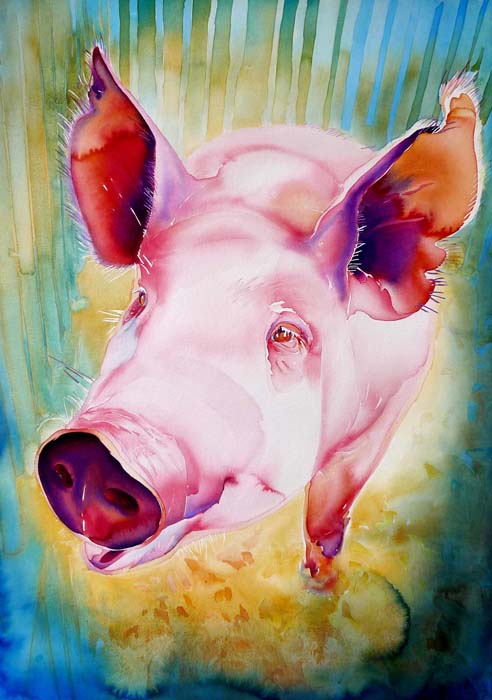
Pig by Carole Carter 2007

But - isn't Groovy the new 'HIP' ?!? Because I dare to argue that WE may just be the new hip!! Think technology, miniaturisation, thinking computers, nano, bio...
Shocking discovery by Chris Beck

Aquarelle watercolours are environmetally friendly, lightweight, refined, ultra detailed, easily miniatured and enlarged, there is fuzzy logic in it and chance - you can do it everywhere and the result is light & poetic, it is difficult to do, interesting and an acquired taste. 

It may not be for everybody yet - but I see a very groovy future for our medium!!

Thursday, 7 April 2011

The Watercolour Exhibition in Tate III

As promised for some time now, I was going to write something in reaction to the article of Waldemar Januszczak in the Sunday Times, that criticises  the Watercolour exhibition in the The Tate Britain... If you click the scan you can read it for yourself:

THE article... illustration by William Turner
(a watercolour and not a pure aquarelle, look at the yellow...)

The article is a great read and has an introduction that shows Waldemar understands - he sais familiar things!
How about:
"[watercolours are] difficult to display - not only does exposure to sunlight begin to dim watercolours the moment they are out of the box, if you hang a row of them on a wall, they will usually fail to impose themselves on your imagination in a visceral way. There is something timid about he medium. Something sensitive, something inherentely unsuited to the bunga-bungaworld in which we find ourselves..."
and
"...this aspect of watercolour, its facility for miniaturisaton is a feature too..."
Yep, that's us, with the one-hair brush! Much more difficult for the users of the thicker media of course.
and about some 17th century beautifully precise flowers and animal watercolours he goes on:
"Technically, these are scientific illustrations with a scientific purpose in mind. What is being celebrated here is watercolours' excellent portability and descriptive usefulness. Un-technically, some instinctive associaton between watercolour and the yearning for paradise is also being sensed here. Innocence seems te be a watercolour quality too ..."

OK- so we established that he understands the medium- the point of his article is however, that watercolours aren't sexy, or "Groovy" and that the Tate has therefore put up work that can't be called watercolours:
"[the] organisers are so fearful of watercolour being seen as mumsy or old-ashioned they shovel in a host of contemporary practitioners who are undeserving of inclusion"


And that's a subject we'll discuss later, aquarellista Sandra Seymour-Dale is visiting the expo as we speak and we'll wait for her verdict (and I may go to London too, a bit later). The only thing I would like to argue, right now, for the record, is that serious and groovy watercolour artists do exist. They work in a serious and actual, nowadays style, abstract, surrealist, scientific, inspired by street art, etc. etc. They have something to tell and they do that with the poetic, fragile, transparent medium of aquarelle watercolours, in the tradition of Turner and Girtin and Cozens... In the coming time I'll show some watercolours that I think represent the 'groovy' that he refers to...
'Renew' a large size watercolour by Catherine Earle

Monday, 28 March 2011

Vote for my portrait!

It would be so great if a struggling artist could actually win an artistic year all paid for! Or just a whopping 2500$! That's what you can help me with, by voting for my artwork - every day! If you want to bookmark it, the link is:

http://marinakulik.see.me/aw2011

and you can also click on the image on the left...

Rate my portfolio by clicking a star (the fifth is the highest) and you're done!

THANKS!!

Win or not, my gratefulness to you, my dear voters, will be endless! I have no clue how other contestants do - it is not very 'transparent' - but I needed over 5000 for the Saatchi vote and this is probably in the same line, so, a long road to go... But I keep the faith ha ha...The contest ends April the 15th

Sunday, 27 March 2011

Guan Weixing

I know, I know, I promised to write a reaction on the article by Waldemar Januszczak in the Sunday Times  that said that watercolours couldn't be groovy - and I will, but one way or another the words won't come... In the meantime I'd like to introduce this Chinese MASTER aquarellista: Guan Weixing

Guan Weixing
And especially recommend his portraits, because they are so unbelievably, breathtakingly  good...
Backlighting - Guan Weixing
He is that good since 1962, so there's definitely consistency there...
Widower - Guan Weixing
Weixing is regarded as one of the most authoritative and influential watercolourists. He has a blog but unfortunately that is in Chinese... I have placed a link to his website (in English) in the Aquarellista blog's link-list and I recommend you to go there -and enjoy big time!!

Monday, 21 March 2011

Expo Aquarellistas in Dutch Consulate in Nice

From March 1st onwards, until 2012, a couple of aquarelle watercolours created by the Marina Artist Team will be on display in the Dutch Consulate in Nice. The Marina Artist Team are Marina Kulik, Marina Teding-van Berkhout and Cathie van der Stel, three aquarellistas, who work together on commissions for houses, portraits (of people and pets) and wedding bouquets.

The Consulate already owns a portrait in aquarelle of her Majesty Queen Beatrix of the Netherlands, made by Marina Kulik.

Shown are a puppy 'Senna' and 'Grapes' by Marina Teding van Berkhout


'Black Beauty' a portrait and 'Poppies' by Cathie van der Stel

'Helena' a portrait of a little girl and 'Cat & Frog' by Marina Kulik.


All aquarelles on display are for sale and the MATeam looks forward to your commissions!
The exhibition is open to everybody visiting the Dutch consulate - which will most probably Dutch people, hence the Dutch translation below...

Vanaf 1 maart jl tot 2012, zijn er zes aquarellen, gemaakt door het Marina Artist Team, te zien in het Nederlands Consulaat te Nice. Het Marina Artist Team bestaat uit Marina Kulik, Marina Teding-van Berkhout en Cathie van der Stel, drie ‘aquarellista’s’, die samenwerken aan opdrachten voor huizen, portretten (van mensen en dieren) en bruidsboeketten.
Het consulaat heeft al een aquarel van Marina Kulik in haar bezit, namelijk het portret van Hare Majesteit Koningin Beatrix.
Er hangen een Berner Senner pup en Druiven van Marina Teding van Berkhout, een portret van een prachtige donkere vrouw en klaprozen van Cathie van der Stel en een portret van een klein meisje en ‘Cat & Frog’ van Marina Kulik. De tentoonstelling is te bezichtigen door iedereen die het consulaat bezoekt. Alle getoonde schilderijen zijn te koop…en het Marina Artist Team is ook zeer geinteresseerd in uw opdrachten!

Saturday, 12 March 2011

The Sunday Telegraph Watercolour Competition

The Sunday Telegraph is launching a watercolour painting competition for enthusiastic amateurs! The closing date is 23 March and everything is explained in the following article (click the link to read)

Bibbi Isaksson
 I'm sure this could be very interesting for those amongst you who are not 'professional' artists - which to my opinion has nothing to do with the quality of your work, it just means that it is not how you make your living...

Sandra Seymour-Dale

The contest was inspired by the Watercolour exhibition in the Tate Britain, about which I wrote in the previous post and I owe you one more in the next...
Cathie van der Stel

NB: The illustrations are randomly chosen great watercolours